
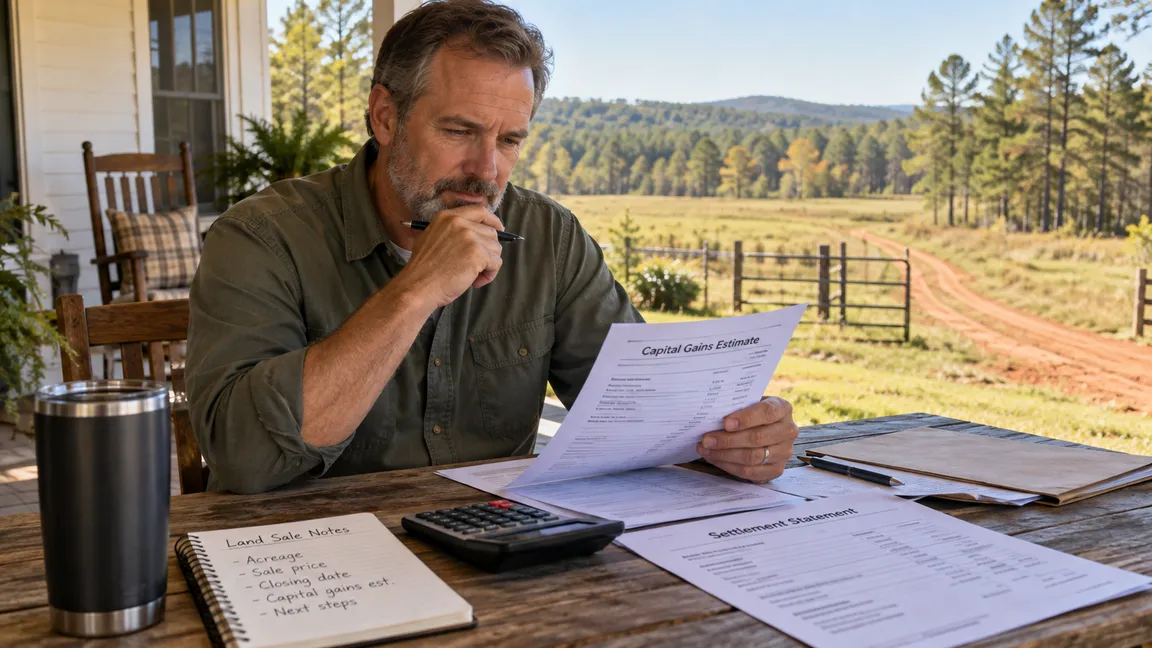
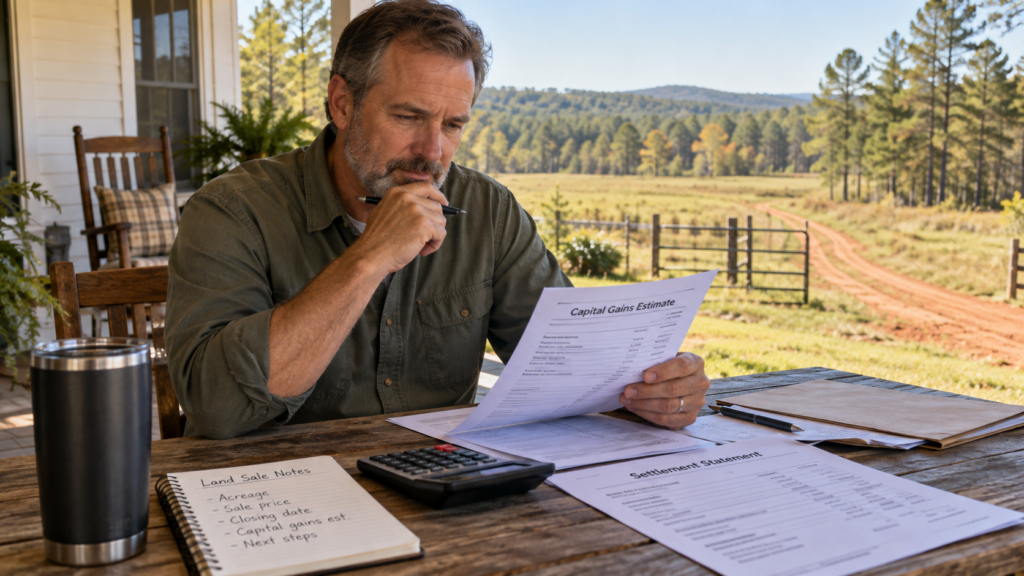
If you’re getting ready to sell a piece of land in Alabama, there’s a good chance the profit — not just the sale price — is what you should be thinking about. The IRS and the state of Alabama both want a share of any gain you make on the sale, and depending on how long you’ve owned the property, how much it’s appreciated, and your overall income, that share can be a meaningful chunk of your proceeds. Here’s a plain-language breakdown of how capital gains tax works when you sell land in Alabama in 2026, and a few legitimate ways sellers reduce what they owe.
A quick note before we start: this is general information, not tax or legal advice. Tax situations vary a lot based on your income, how the land was acquired, and what you plan to do with the proceeds, so it’s worth a conversation with a CPA before you close.
What Counts as a Capital Gain on Land
Your capital gain is the difference between your “basis” in the property — generally what you paid for it, plus the cost of improvements like a survey, road, or well, minus any depreciation if it was ever used for business — and what you sell it for, minus selling costs like closing fees. If you bought a 20-acre tract for $60,000, spent $5,000 clearing an access road, and sell it for $110,000 after $4,000 in closing costs, your taxable gain is roughly $41,000.
How that gain is taxed depends heavily on how long you’ve owned the land:
- Short-term gains (property held one year or less) are taxed as ordinary income, at your regular federal tax bracket — which can run as high as 37% for high earners.
- Long-term gains (property held more than one year) get preferential federal rates: 0%, 15%, or 20%, depending on your total taxable income.
Most Alabama landowners selling a tract they’ve held for years — whether it’s a family parcel, an investment purchase, or inherited ground — fall into the long-term category, which is the more favorable one.
Federal Long-Term Capital Gains Rates for 2026
For the 2026 tax year, the federal long-term capital gains brackets are:
- 0% rate: taxable income up to $49,450 (single filers) or $98,900 (married filing jointly)
- 15% rate: taxable income above those thresholds up to $545,500 (single) or $613,700 (married filing jointly)
- 20% rate: taxable income above those upper thresholds
Long-term capital gains “stack” on top of your other income to figure out which bracket applies — the IRS fills up your income with wages and other ordinary income first, then layers your capital gain on top of that. That means a large land sale can push part of your gain into a higher bracket even if your regular income is modest.
High earners should also budget for the Net Investment Income Tax (NIIT) — an extra 3.8% federal tax that applies to investment income, including capital gains, once your modified adjusted gross income exceeds $200,000 (single) or $250,000 (married filing jointly). Land held purely as an investment (rather than, say, land tied to an active farming business you materially participate in) is generally subject to NIIT if you’re above those thresholds.
How Alabama Taxes Capital Gains
Alabama doesn’t have a separate capital gains tax rate — gains from selling land are taxed as ordinary income under the state’s regular income tax brackets. Alabama’s brackets top out fast: single filers hit the top 5% rate on taxable income above $3,000, and joint filers hit it above $6,000. In practice, that means almost every Alabama land seller pays a flat-feeling 5% state rate on their gain, on top of whatever they owe the IRS.
One quirk worth knowing: Alabama is one of the only states that lets you deduct the federal income tax you paid from your Alabama taxable income. That deduction can modestly soften the effective state tax rate on a large gain, which is one more reason to run the numbers with a tax preparer rather than estimate off a rule of thumb.
Legitimate Ways Sellers Reduce What They Owe
None of these are loopholes — they’re standard tools the tax code already provides:
Track your full basis. Many landowners underreport their basis simply because they didn’t keep records. Fees for a survey, perc test, clearing, road-building, or even a portion of property taxes paid during a development phase can sometimes be added to basis. Good records can meaningfully lower your taxable gain.
Time the sale around your income. If you’re close to retirement, took a lower-income year, or have a year with unusually high deductions, selling in that year could put more of your gain in the 0% or 15% bracket instead of the 20% bracket.
Consider a 1031 exchange for investment land. If the property is held for investment or business use (not a personal-use parcel), a Section 1031 like-kind exchange lets you defer capital gains tax by rolling the proceeds into another investment property, as long as you follow strict IRS timelines and use a qualified intermediary. This doesn’t apply to land you’ve simply held for personal enjoyment or that’s your primary residence’s yard.
Use an installment sale. Spreading the sale price over multiple years through seller financing can spread the taxable gain across those same years, potentially keeping you in a lower bracket in each one rather than taking the full hit at once.
Know your basis if the land was inherited. Inherited land typically gets a “stepped-up” basis to its fair market value on the date of the previous owner’s death, which can dramatically shrink — or even eliminate — the taxable gain compared to what the original owner paid decades earlier. If that’s your situation, our guide to selling inherited land in Alabama walks through the probate and title side of things too.
What If the Land Also Has Back Taxes or a Lien?
Capital gains tax is separate from any delinquent property taxes or liens attached to the parcel — those get resolved out of the sale proceeds at closing, while capital gains tax is a separate bill you handle on your tax return. If your land has back taxes or a lien on top of a gain you’re trying to plan around, it’s worth untangling both issues before you list or accept an offer.
A Few Common Questions
Does selling to a cash buyer change how capital gains tax works? No. The tax treatment is based on your gain and holding period, not who buys the land or how the deal closes. A cash sale can close faster and with fewer contingencies, but it doesn’t change what you owe the IRS or the state.
Do I owe capital gains tax if I sell at a loss? No — if your sale price minus selling costs is less than your basis, you have a capital loss, not a gain, and there’s no capital gains tax due. Losses on personal-use land generally aren’t deductible, but losses on investment property may be, depending on your situation.
Is there a way to avoid Alabama state tax on the sale specifically? Not really, short of the federal-tax deduction mentioned above — Alabama taxes the gain as regular income once it’s federally taxable, so most of the planning opportunities (basis tracking, timing, 1031 exchanges, installment sales) work at the federal level and simply flow through to your state return.
Should I get a CPA involved before I sell? If the gain is more than a few thousand dollars, yes. A short consultation before you sign anything is usually far cheaper than an unplanned tax bill after the fact.
The Bottom Line
Selling land in Alabama almost always means dealing with capital gains tax in some form, but the amount you actually owe depends heavily on your basis, your holding period, your income, and a few planning tools most sellers don’t know exist. Running the numbers before you sell — not after — is what actually saves money.
If you’d rather skip the listing process altogether and get a straightforward, no-obligation cash offer on your land, get your offer started here or call (850) 290-7090. We buy land across Alabama as-is, and we’re happy to walk through how a direct sale might affect your specific numbers.