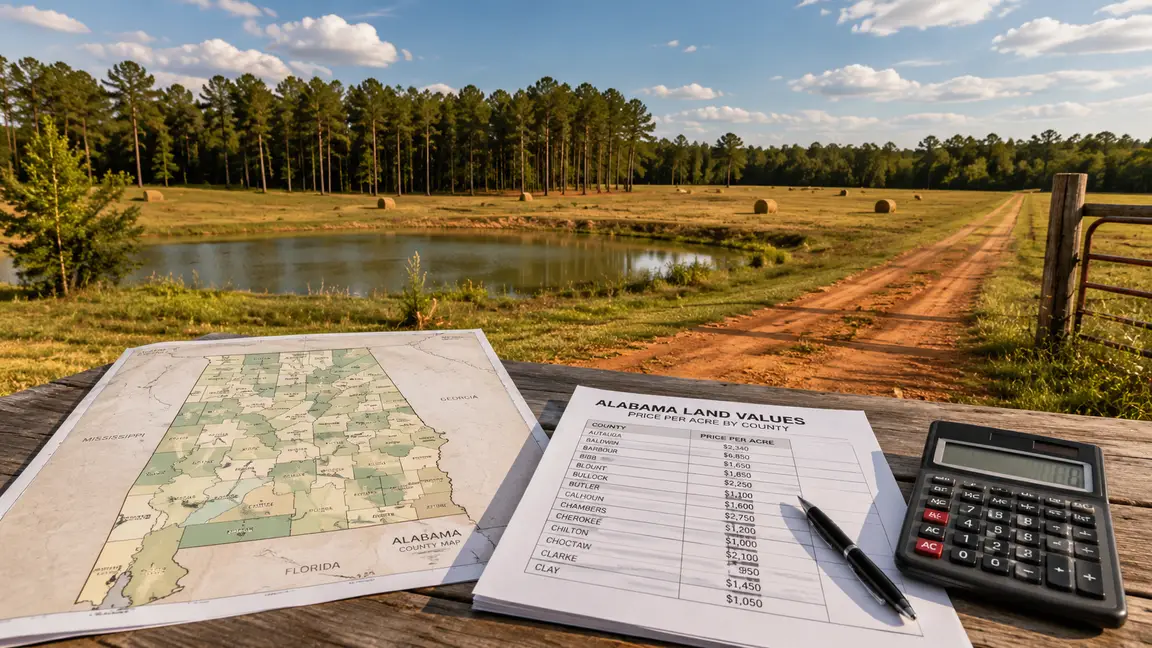
If you’ve searched “how much is my land worth” and landed on a page full of formulas and no actual numbers, you’re not alone. Landowners across Alabama ask the same question every day, and most of the answers online are vague on purpose. This guide is different: real 2026 price-per-acre ranges, broken down by region, so you can see where your land likely falls before you talk to anyone.
Statewide, Alabama land is averaging somewhere between $3,600 and $3,900 per acre in 2026, up roughly 9–10% from a year ago, with sales volume also climbing. But that statewide number hides enormous variation. An acre outside Gulf Shores and an acre in the Black Belt can differ by 10x or more. Where your parcel sits — and what’s around it — matters more than almost anything else.
Why Alabama Land Prices Vary So Much
Two 20-acre tracts can look identical on paper and sell for wildly different prices. The gap usually comes down to a handful of factors:
- Location and proximity to growth. Land near Huntsville, Baldwin County’s Gulf Coast corridor, or I-65/I-85 interchanges commands a premium simply because development is chasing it.
- Road access and utilities. A parcel with paved road frontage and power already run to the property line is worth more than an identical landlocked tract a mile away.
- Timber and agricultural value. Merchantable timber, tillable acreage, or pasture with fencing adds real dollar value beyond raw land price.
- Water features and topography. Frontage on a lake, river, or creek — or simply usable, buildable terrain instead of a ravine — pushes price up.
- Zoning and current-use classification. Land enrolled in Alabama’s current-use agricultural valuation can carry very different tax and resale dynamics than land zoned for residential or commercial use.
Alabama Land Prices by Region (2026)
These are general 2026 ranges based on recent market activity. Your specific parcel could fall outside these bands depending on its condition, access, and exact location — but they’re a solid starting point.
Black Belt (Wilcox, Greene, Sumter, Dallas Counties)
This is historically the most affordable part of the state for land buyers, and it still is. Undeveloped agricultural and timber tracts in the Black Belt typically run $1,500 to $3,500 per acre, with some counties like Wilcox, Greene, and Sumter still offering land under $2,000 per acre. If you own rural acreage in this region, don’t assume it’s worthless — it just prices differently than land closer to a metro area.
Wiregrass / Southeast Alabama (Coffee, Houston, Dale Counties)
Farmland and timberland in the Wiregrass region generally sells in the $2,500 to $6,000 per acre range, with row-crop and well-located tracts near Dothan and Enterprise at the higher end. Land for sale in Houston County and surrounding counties tends to track closely with regional ag land values.
North Alabama (Huntsville, Madison, Limestone, Marshall, DeKalb Counties)
North Alabama is a mixed bag. Land close to Huntsville’s tech and manufacturing growth can command a real premium, while hunting-focused hill country parcels — especially near the Tennessee River — typically run $3,000 to $7,000 per acre, depending on timber quality and road access. If you own land in Marshall County or Limestone County, recreational and hunting demand is a real driver of value here.
Gulf Coast (Baldwin and Mobile Counties)
Baldwin County is the most expensive land market in the state by a wide margin. Parcels near Gulf Shores, Orange Beach, and the I-10 corridor can run $8,500 to $16,000+ per acre, and select development-adjacent tracts have sold for $25,000 to $35,000 per acre. Tourism growth and coastal development pressure have pushed values up an estimated 12% or more since 2023. If you’re sitting on land in Baldwin County, it’s worth getting a real number rather than guessing.
Central Alabama (Jefferson, Shelby, Elmore, Montgomery Counties)
Land near Birmingham, the I-65 corridor, and fast-growing Shelby County tends to price closer to $4,000 to $9,000 per acre for well-located tracts, while more rural pockets of Elmore and Montgomery counties fall closer to the statewide average.
What Actually Moves Your Number
Regional averages are a starting point, not a final answer. When we evaluate a specific tract, the things that move the number up or down the most are:
- Distance to the nearest paved road and whether utilities are already at the property line
- Whether the parcel is landlocked or has a legal easement
- Timber maturity and merchantable volume, if wooded
- Flood zone status and usable (buildable) acreage versus wetland or floodplain
- Any liens, back taxes, or title issues attached to the property
None of these are dealbreakers — they just affect the final number, and a direct buyer can factor them in without asking you to fix anything first.
How to Use These Numbers If You’re Selling
Think of these ranges as a sanity check, not an appraisal. If a number you’re hearing is wildly outside your region’s range, ask why. If it’s in the ballpark, you’re likely looking at a fair reflection of today’s market. For a deeper look at how landowners typically estimate value on their own, see our full Alabama land valuation guide — this article is meant to complement that one with real regional pricing, not replace it.
Get a Real Offer, Not Just an Estimate
Price ranges are useful, but they’re still averages. The fastest way to know what your specific parcel is worth is to compare your options for selling land in Alabama and get an actual number in hand. We Buy Alabama Land buys land as-is — landlocked, wooded, under a lien, doesn’t matter — with no commissions, no listing, and no waiting on a buyer to show up. If you’d rather skip the guesswork, get your no-obligation cash offer today and see what your land is actually worth in 2026.