
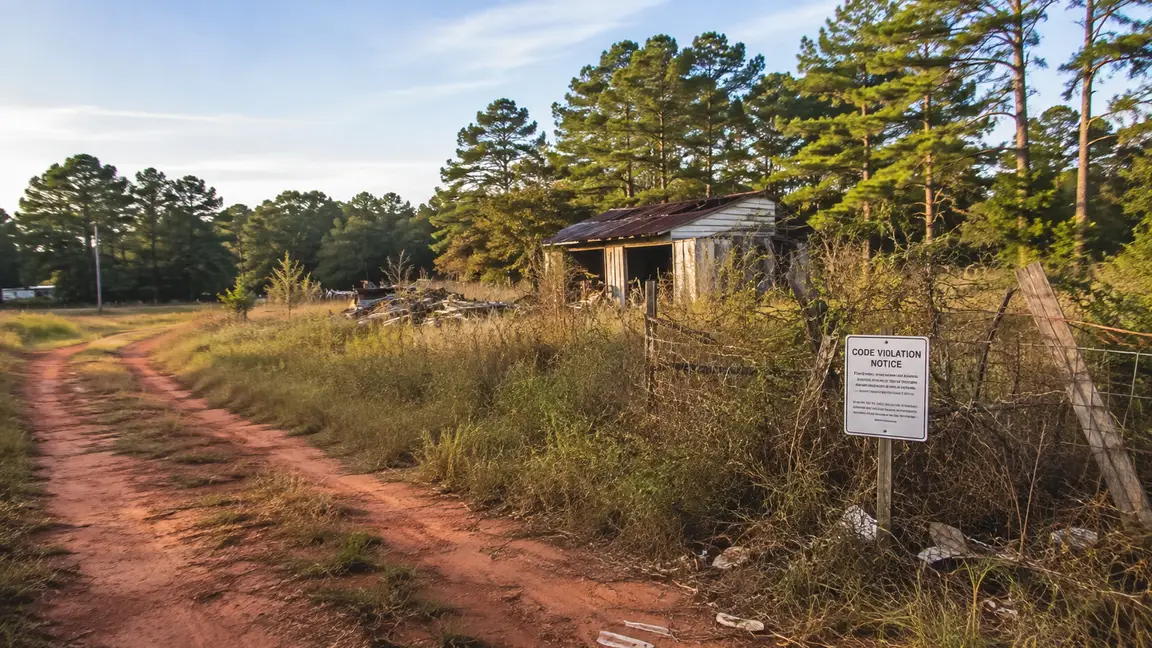
If a county or city has flagged your vacant land for a code violation — overgrown weeds, illegal dumping, an old mobile home that never got torn down, an unpermitted structure — you’re probably wondering whether you can even sell the property, let alone what it means for the price. The short answer: yes, you can sell land with an open violation in Alabama. But you do need to understand what you’re dealing with before you list it or field an offer.
This guide covers what actually counts as a code violation on vacant land, how it affects a sale, what Alabama law says about disclosing it, and the realistic paths to getting the property sold.
What Counts as a Code Violation on Vacant Land
Code enforcement in Alabama happens at the county or municipal level, so the specific rules vary depending on where your land sits. That said, the most common violations counties and cities cite on vacant or lightly-used land include:
- High grass and weeds — most local ordinances set a limit (often around 12 inches) before a property is cited for overgrowth
- Illegal dumping or junk accumulation — trash, construction debris, or discarded materials left on the property
- Inoperable or junk vehicles — most municipalities allow one, with anything beyond that subject to citation
- Unpermitted structures — sheds, mobile homes, fencing, or other improvements built without the required permits
- Zoning misuse — using the land in a way that conflicts with its current zoning designation (running a business on residentially-zoned land, for example)
If you inherited the property, bought it years ago and haven’t visited since, or simply live out of state, it’s entirely possible a violation exists that you don’t even know about yet. It’s worth calling the county’s code enforcement or planning office directly to ask if anything is on file for your parcel before you go further.
How a Violation Can Complicate a Sale
A code violation doesn’t make land unsellable, but it does change the conversation with a buyer in a few ways.
It can scare off traditional buyers. Anyone planning to build or finance the purchase will typically need a clean title search and may need the violation resolved before closing, since lenders are cautious about properties with open enforcement actions.
It can turn into a lien. Alabama law gives cities and counties the authority to use their police powers to compel a property owner to correct a nuisance condition. If the owner doesn’t act, the local government can step in, abate the condition itself (mowing an overgrown lot, hauling off debris, demolishing an unsafe structure), and then bill the property owner for the cost. If that bill goes unpaid, it can attach to the property as a lien — which then has to be cleared at closing, just like a tax lien.
It can affect price. Buyers who are willing to take on a property with an open violation will usually factor the cost and hassle of resolving it into their offer.
None of this means the land is stuck. It just means the violation needs to be accounted for, one way or another, before the sale closes.
Do You Have to Disclose It?
Alabama is a caveat emptor — “buyer beware” — state, and that rule applies to unimproved (vacant) land. Unlike some states, Alabama doesn’t require sellers of raw land to fill out a formal seller’s disclosure form.
That said, caveat emptor has real limits. Alabama sellers still can’t:
- Conceal a known defect that isn’t visible to a buyer during a normal inspection
- Give a dishonest answer if a buyer directly asks about a specific issue, including an open violation
- Actively misrepresent the condition or legal status of the property
A code violation on file with the county is a matter of public record, so treating it as a secret rarely works out well — a title search or a simple call to the county will surface it anyway. Being upfront about it, even though you’re not legally required to hand over a disclosure form, is usually the safer and more practical move. It also tends to keep a deal from falling apart late in the process, once a buyer discovers the issue on their own.
Your Options for Selling Land With a Violation
1. Resolve it, then sell. If the fix is simple and cheap — mowing overgrown grass, hauling off a small pile of debris — clearing it before you list can widen your buyer pool and avoid awkward conversations during negotiations.
2. Disclose it and price accordingly. If the fix is more involved (an unpermitted structure that needs a permit or removal, for example), you can sell as-is and simply factor the cost of resolution into your asking price. Traditional buyers may still want it addressed before closing, though, which can slow things down.
3. Sell directly to a cash buyer, as-is. This is usually the fastest path when a violation is complicated, expensive to fix, or already has a lien attached. A direct buyer can factor the issue into a cash offer and handle the resolution after closing, so you’re not stuck fixing the property before you can sell it — and you’re not waiting on a buyer’s lender to approve a property with an open violation.
Bottom Line
A code violation on your Alabama land is a solvable problem, not a dead end. The property is still worth something, and there are still buyers who’ll take it as-is. The key is knowing what you’re dealing with, being straight about it, and picking the selling path that fits your timeline and how much cleanup you’re willing to take on.
If you’d rather not deal with permits, county code offices, or a buyer’s financing falling through over an open violation, get a no-obligation cash offer on your land as-is. You can also compare your other options for selling or see how our simple process works before you decide.