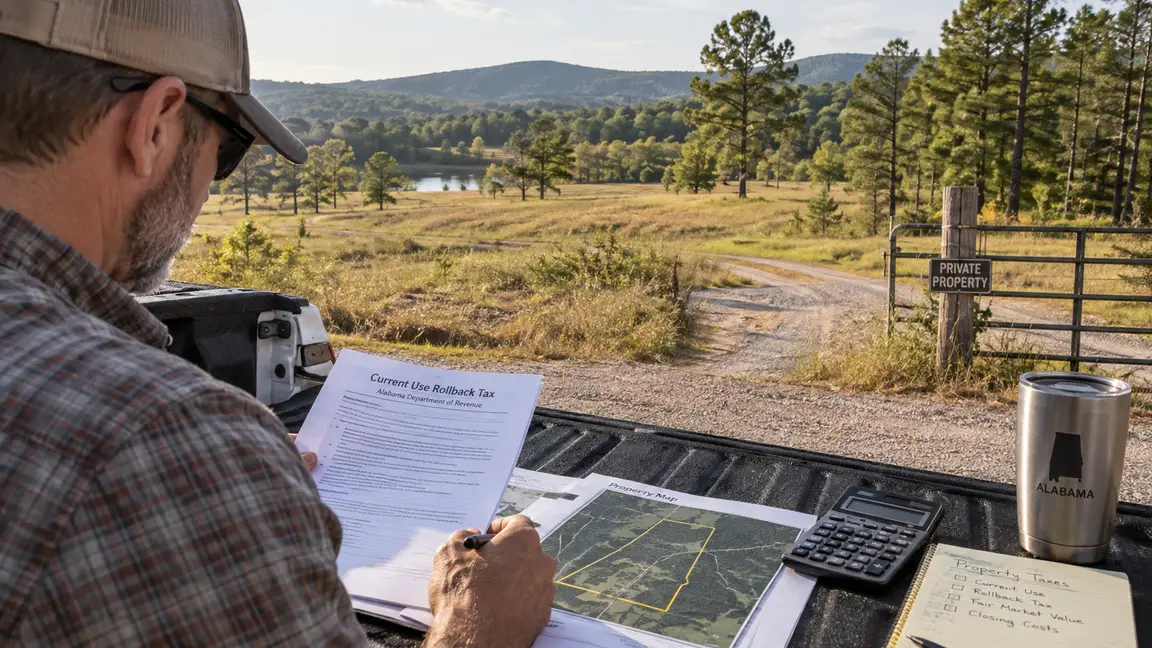
If you own farmland or timberland in Alabama, there’s a good chance your county tax assessor values that property under something called “Current Use” — a program that taxes agricultural and forest land based on what it’s actually used for, not what a developer might pay for it. It quietly saves landowners real money every year.
It can also come with a catch you don’t find out about until you try to sell: the rollback tax.
If your land is enrolled in Current Use and the sale leads to the property being converted to a different use, Alabama law allows the county to go back and collect the difference between what you paid under Current Use and what you would have paid at full market value — for up to three years. Here’s what that actually means for you as a seller, based on the Alabama Department of Revenue’s own guidance on the program.
What Is Alabama’s Current Use Valuation, Exactly?
Alabama has taxed farm and timberland this way since 1978. Instead of assessing your property at fair market value — which can be inflated if your land sits near a growing city or a new subdivision — the state assesses it at “current use value,” based on the income the land can reasonably produce as farmland or timberland. The idea, according to the Alabama Department of Revenue, is straightforward: a farmer shouldn’t be taxed as if their cropland were a future shopping center just because it’s close to one.
To qualify, a property has to fall under what the state calls “Class III” property, which includes:
- Agricultural and forest land used for raising, harvesting, or selling crops, livestock, or timber
- Owner-occupied single-family residential property
- Certain historic buildings and sites
Recent state figures put the maximum current-use value at roughly $532 per acre for the best cropland and around $827 per acre for timberland — a fraction of what comparable land often sells for on the open market, which is exactly why the tax savings can be significant, and why a rollback can come as a real surprise.
How the Program Works — and Why It Matters When You Sell
Getting into Current Use requires an application with your county’s tax assessing official, filed between October 1 and January 1. Once you’re in, you don’t have to reapply every year — the status stays attached to how the property is used.
Here’s the part that trips up a lot of sellers: when the land changes hands, the new owner has to file their own Current Use application during that same October 1–January 1 window, or the property reverts to full market value assessment. That’s worth mentioning to a buyer during negotiations, since it directly affects what they’ll pay in property taxes going forward. If you’re weighing how to position the sale, it helps to first compare your options for selling land in Alabama so you know what buyers in your situation typically expect.
What Actually Triggers a Rollback Tax
Under Section 40-7-25.3 of the Code of Alabama, a rollback can apply in two situations:
- The property is sold and then converted to a use that doesn’t qualify for Current Use — a subdivision, a commercial pad site, a solar farm, and so on — within two years of the sale.
- The property is converted to a disqualifying use while you still own it, regardless of a sale.
When a rollback applies, the county recalculates what you would have owed in property taxes at market value (using the sale price or the fair market value, whichever is higher) instead of the Current Use value. That recalculation covers up to three years immediately before the October 1 that follows the conversion — or fewer years if the property hadn’t been in Current Use that long.
There’s one detail that catches sellers off guard: the additional tax is billed to whoever owns the property on the October 1 following the conversion — not necessarily the person who sold it or the person who converted it. If a sale closes, the buyer converts the land a few months later, and ownership has changed hands again by the time that October 1 lien date rolls around, the rollback bill can end up on a completely different owner’s desk than the one who triggered it. This is exactly the kind of detail worth confirming with the county revenue office, or with a real estate attorney, before you sign anything.
A Simple Example of How Rollback Math Works
Say a 40-acre timber tract has been assessed under Current Use for the past five years. The owner sells it, and within a year the new owner clears it for a residential development — a use that no longer qualifies for Current Use valuation. The county assessing official will then look back at the three tax years leading up to the October 1 following that conversion, recalculate what the property taxes would have been at fair market value (using the sale price or appraised market value, whichever is higher) instead of the Current Use value, and bill the difference to whoever owned the parcel on that October 1 date. Because the land had been in Current Use for more than three years already, the full three-year lookback applies. If it had only been enrolled for, say, eighteen months, the lookback would be limited to that shorter period instead.
The exact dollar amount depends on your county’s assessment ratios and the property’s specific market value, which is why this is ultimately a conversation for your county revenue office rather than a fixed formula — but the mechanism itself is consistent statewide.
Common Questions From Alabama Land Sellers
Does a rollback apply if I just sell the land and the buyer keeps farming or logging it? No. Rollback provisions are tied to a change in use, not a change in ownership. A sale by itself doesn’t trigger anything as long as the qualifying use continues.
What if my land has only been in Current Use for a year or two? The lookback period can’t exceed the actual number of years the property was enrolled, so a shorter enrollment history generally means a smaller potential rollback exposure.
Who’s actually responsible for paying a rollback tax bill? By statute, it’s charged to the owner of record as of the October 1 following the conversion — which is why timing and clear communication with your buyer matter so much if a use change is anywhere on the horizon.
Does this have anything to do with delinquent property taxes or tax liens? No — rollback tax is a separate mechanism from delinquent taxes and liens. If your land has back taxes or a lien attached instead, that’s a different process with its own timeline and options.
What This Means If You’re Selling Ag or Timber Land
The good news: simply selling land that’s enrolled in Current Use doesn’t automatically trigger a rollback. If the buyer intends to keep farming it, keep it in timber production, or otherwise keep it in a qualifying use, there’s typically nothing to roll back. The risk shows up when the land’s use is about to change — either because you know a buyer plans to develop it, or because you’re the one converting the use before selling.
Practically, that means it’s worth a phone call to your county’s revenue office before you list the property to confirm your parcel’s Current Use status and ask what would happen under different sale scenarios. It’s also worth being upfront with any buyer about how the property is currently classified, since it affects their taxes too, not just yours.
Selling for Cash Sidesteps the Guesswork
If your land has been sitting in Current Use for years and you’re not sure how a traditional sale — with financing contingencies, a slow closing, and an uncertain end use — might affect your tax exposure, a direct cash sale can simplify things considerably. We buy land across Alabama as-is, and we can walk through your specific parcel’s tax situation with you before you commit to anything. Curious what that actually looks like day-to-day? Here’s how our simple cash-offer process works.
Every county handles the fine points of current use and rollback calculations a little differently, and the numbers above reflect the state’s general framework rather than your specific parcel, so it’s always worth a quick call to your county assessing official to confirm the details before you sell.
Ready to talk through your options?
If you own farm or timberland in Alabama and want a straightforward, no-obligation cash offer — with no need to untangle rollback tax questions on your own — get your cash offer started here or call (850) 290-7090.